Lucky Pays Games: Slots, Tables, Live Casino and Sports
 Available in GB
Lucky Pays lists games from 59 providers and covers the main categories most players expect: slots, table games, live casino and crash games. Betting and sports-betting products are also present. That breadth is more useful than a headline total game count, because catalogue totals can change as titles are added, removed or restricted. The useful reference points are the current categories and provider breadth rather than a fixed title count that may become stale.
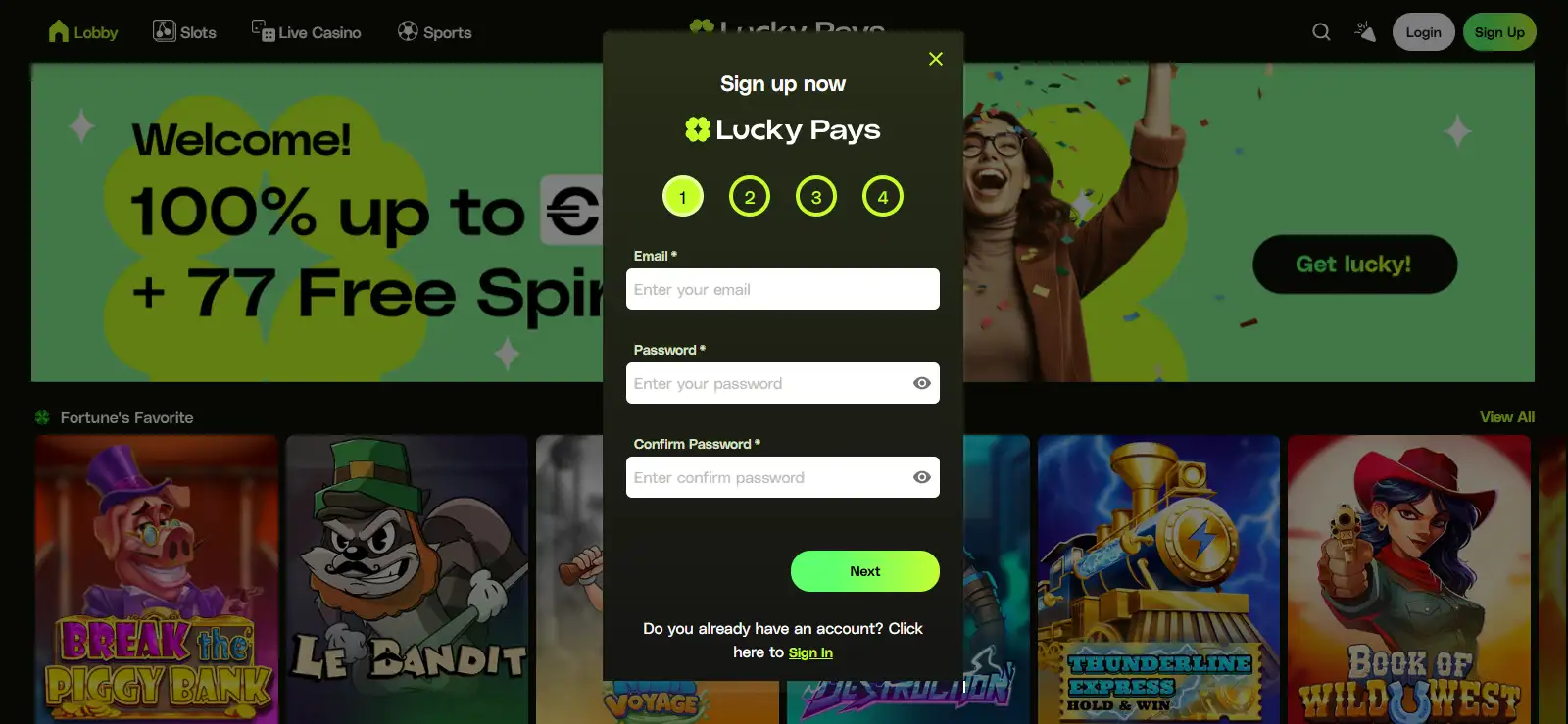
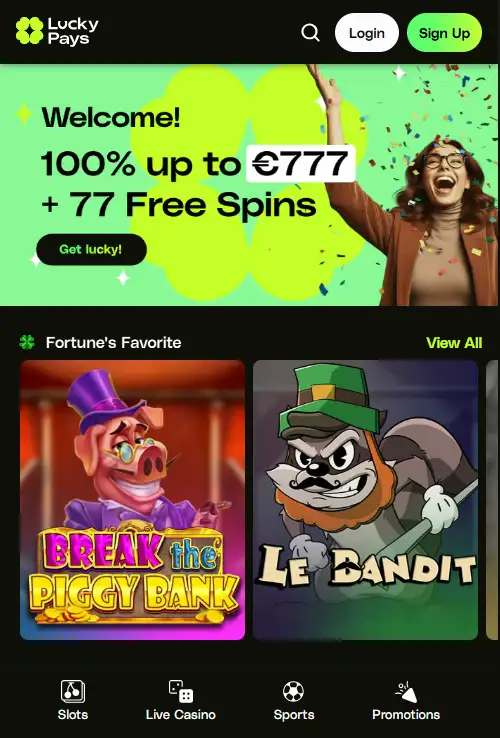
For a UK reader, the practical question is not simply whether the lobby looks large. It is whether the categories you actually want are easy to find, whether the account and stake display make sense for you, whether games work well on your device, and whether the operator’s regulatory position matches your expectations. Lucky Pays works through a mobile browser, and its account currency is reported as EUR, so those points deserve attention when assessing a game lobby from Great Britain.

The Lucky Pays game library at a glance
The clearest measure of catalogue breadth is the provider count: Lucky Pays lists games from 59 providers. That does not tell you how many individual titles are available at this exact moment, but it does indicate that the catalogue is assembled from a broad supplier base rather than a very small in-house selection. The categories include slots, roulette, blackjack, baccarat, live games and crash games. These can be grouped into slots, conventional table games, live casino and crash-style games, with sports betting sitting alongside the casino product.
Provider breadth and title count answer different questions. A total title count is a point-in-time measure of inventory. It can change when a supplier rotates content, a jurisdiction restricts a title, or the operator changes its lobby. A provider count is also subject to change, but it is a more stable way to understand whether the library draws from many separate studios. A fixed overall game count is less useful because availability can change; the provider list currently spans 59 suppliers.
From a user perspective, category structure matters at least as much as size. A useful lobby should let you move between slots, live tables and other formats without forcing you to scroll through one undifferentiated list. Search and filtering are especially important when a catalogue spans dozens of suppliers. When checking Lucky Pays, look for category navigation first, then confirm whether you can narrow the selection by the game type or provider you already use.
What the Lucky Pays catalogue includes
Lucky Pays has a 59-provider catalogue, with slots, table games, live casino and crash games represented. Sports-betting products are also present. A fixed total number of individual game titles is not used because the catalogue can change.
For comparison purposes, the provider count is more informative than a headline total that can change whenever titles are added, removed or temporarily unavailable. A 59-provider catalogue points to breadth across the verified categories without implying that every supplier contributes the same number of games or that every title is visible on every device. Use the categories to narrow the lobby first, then judge the current selection that actually appears in the account you are using.
Slots and game discovery
Slots are part of the Lucky Pays catalogue. A recognisable title shown in an older review does not guarantee that the same game remains available today. Start with the current categories and supplier breadth, then use the live lobby to check the specific titles you care about.
For practical discovery, use three checks. First, see whether the lobby offers a dedicated search control rather than relying only on promotional carousels. Second, check whether provider filters are visible and useful. A 59-provider library can become difficult to browse if all studios are mixed together. Third, look at how the lobby separates slots from table games, live casino and crash products. Clear separation reduces the chance of mistaking a live variant, instant game or sportsbook product for a standard slot.
UK readers should also pay attention to the currency and bet display. Lucky Pays accounts are reported in euros, while pounds are the local reference currency in Great Britain. Do not assume that a GBP-looking promotional page means your account balance or in-game stakes will be denominated in GBP. Before playing, confirm the account currency shown after sign-in and the currency displayed inside the selected game. That is especially relevant when comparing stake sizes or setting a personal spend limit.
Another useful check is availability before depositing. Game catalogues can vary by device, supplier availability and location. If one specific slot is the reason you are considering the site, search for it while browsing the current lobby rather than treating a historical review list as a guarantee. This approach gives more decision value than an inflated catalogue headline because it tests the one thing that matters: whether the game you want is actually accessible when you intend to play.
A useful slot search starts with the lobby tools rather than an advertised total. Open the slots category, try the available filters and search for the themes or mechanics you actually prefer. If provider filters are present, they can help you understand how the stated 59-provider breadth is distributed without turning that number into a fixed title count. The same method also catches changes that an old review cannot: a title may be removed, a supplier may be temporarily absent, or the mobile view may surface a different subset first.
Table games and live dealer play
Lucky Pays’ casino categories include roulette, blackjack and baccarat, alongside live games. That means players can look beyond slots without relying on an inferred table-game offering. The distinction between digital table games and live dealer tables is worth keeping clear. A conventional roulette or blackjack game is software-driven, while a live table uses a streamed dealer or studio presentation. Live casino is present as a category, but table counts and studio availability can change.
For live play, current lobby inspection is more informative than a static inventory. Look at which table types are actually open, what stakes the interface displays, and whether the rules panel is available before you commit funds. Limits can differ from table to table, so check the stake range on the table you intend to use. Named studios should also be confirmed in the current lobby rather than treated as guaranteed options.
The live casino page goes deeper into how to evaluate live tables on desktop and mobile. The key point on this broader games page is that live casino is part of the offering, not an assumed extension of the slot catalogue. If live dealer play is your main interest, use the live-casino page to check stream usability, displayed limits, rules and mobile behaviour rather than relying only on the presence of a Live Casino menu item.
For table games generally, compare the information available before opening a game. Rules, bet ranges and currency display should be understandable from the lobby or game interface. If a game requires opening the full client before you can see essential limits, make that part of your assessment. A large library is less useful when basic decision information is difficult to locate.
Treat standard table games and live dealer games as related but distinct parts of the lobby. A digital table title runs in the casino interface, while a live table adds a streamed dealer, scheduled table availability and displayed betting limits. That difference matters when you compare usability: a game can fit a phone screen well while a live stream feels cramped or depends more heavily on connection quality.
For live play, use the dedicated live-casino guide to check the current tables, rules, displayed limits and mobile stream. Use the main games page to confirm the broader categories rather than to freeze a temporary table list into a permanent inventory.
Crash games and sports betting
Crash games are included in the Lucky Pays casino categories. These products behave differently from traditional slots and table games, so the useful question is whether the lobby labels them clearly and keeps their controls easy to understand. Rather than assuming every crash game follows the same mechanics, read the rules for the specific title you open. The category label confirms the product type is available; it does not establish identical multipliers, features or risk controls across every game.
Lucky Pays also includes betting and sports-betting products alongside the casino. Judge the betting interface separately by its current sports coverage, markets, odds presentation and settlement rules.
If you plan to use the betting side, evaluate it separately from the casino catalogue. Check the sports and market coverage shown in the current interface, how odds are presented, which settlement rules apply and whether the account currency works for you. Do not assume that the depth of the casino provider list predicts sportsbook depth. They are separate products even when they share one account.
Casino players can focus on the provider-led catalogue, while sports users can inspect the current betting menu separately. The two products share an account but should be evaluated on their own features.
Crash games sit alongside the casino categories, while sports betting is a separate product area. That distinction is useful when judging the site because the things you need to inspect are different. For crash play, look at the current game screen, rules and stake display. For sports, judge the betting interface by the markets, events and bet information shown when you use it rather than assuming the casino provider count says anything about sportsbook depth.
Keeping sports inside this broader product review also avoids overstating what is known. The verified point is that sports betting is present. A fuller assessment of league coverage, odds features or settlement rules would require current sportsbook-specific evidence, so those details should be checked in the live product instead of inferred from the casino catalogue.
Great Britain slot rules as market context
Great Britain has specific maximum stake rules for online slots attached to remote casino operating licences. The Gambling Commission’s current guidance states that the maximum stake per game cycle is £5 for adults aged 25 and over and £2 for adults aged 18 to 24. The rules apply to online slots, not to other casino games such as roulette or blackjack. They came fully into effect during 2025.
That rule is useful market context, but it must not be misread as a Lucky Pays product setting. The £5 and £2 limits are requirements for GB-licensed remote casino operators, not stated Lucky Pays controls. Compare the limits shown in the current Lucky Pays game interface with your own budget, and treat Great Britain rules as the benchmark for licensed operators rather than as a description of this site’s configuration.
If your priority is playing within the Great Britain regulated framework, verify the operator in the Gambling Commission’s public register and check the licence details before depositing. A familiar game category, a pound symbol in marketing, or a site being reachable from a UK device does not by itself establish that the operator holds a GB remote casino licence. Regulation and game availability are separate facts.
For the broader regulatory context, use the licence and UK rules page. It addresses the operator’s regulatory position and the protections that do or do not follow from it. Keeping those questions separate avoids turning a game library description into an unsupported compliance claim.
The Great Britain stake caps are useful as a reference point because they show how online slots are constrained for operators holding the relevant UKGC remote casino licence. They do not establish the stake settings on Lucky Pays. When you open a slot, the amount displayed in the game interface is the product fact to inspect; the GB cap is regulatory context for licensed Great Britain operators.
This separation becomes especially important when a review is read from outside Great Britain or when a casino holds a different licence. A reader can compare the stake controls visible on the site with the GB-licensed baseline, but should not describe one as evidence of the other. If the presence of UKGC protections is important to your decision, verify the licence status independently rather than using game limits as a proxy for regulation.
How UK players can assess the Lucky Pays game lobby
Assess the Lucky Pays game lobby from the current site rather than an old headline count: confirm the categories and providers you care about, then check whether the specific titles you want are actually visible.
Use the reported provider breadth as context rather than a promise that every supplier or title will remain available, and check the live-casino section separately when table availability matters.
Verify how the games behave on the device you intend to use and pay attention to the account currency and any stake display that affects your budget.
For the wider decision, use the mobile guide and full review alongside the current lobby so that catalogue changes do not become permanent claims.
Prepared by the Lucky Pays Casino editorial staff.