Lucky Pays Licence and UK Regulatory Status
 Available in GB
Lucky Pays is associated with Igloo Ventures SRL and an Anjouan gambling licence, number ALSI-142311005-FI2. The current Great Britain Gambling Commission register check did not identify a UKGC licence for Lucky Pays or Igloo Ventures SRL. Those are separate facts: an offshore licence does not become a Great Britain licence simply because UK readers can reach the site.
For readers in England, Scotland and Wales, the practical comparison is the Great Britain licensing system. Operators providing remote gambling to consumers in Great Britain generally need the appropriate Gambling Commission operating licence. Northern Ireland uses a different legal framework, so “UK licence” is too vague to describe the position accurately. This page explains the licence record, what the UKGC register check means, and which current GB rules belong only to the UKGC-licensed environment.
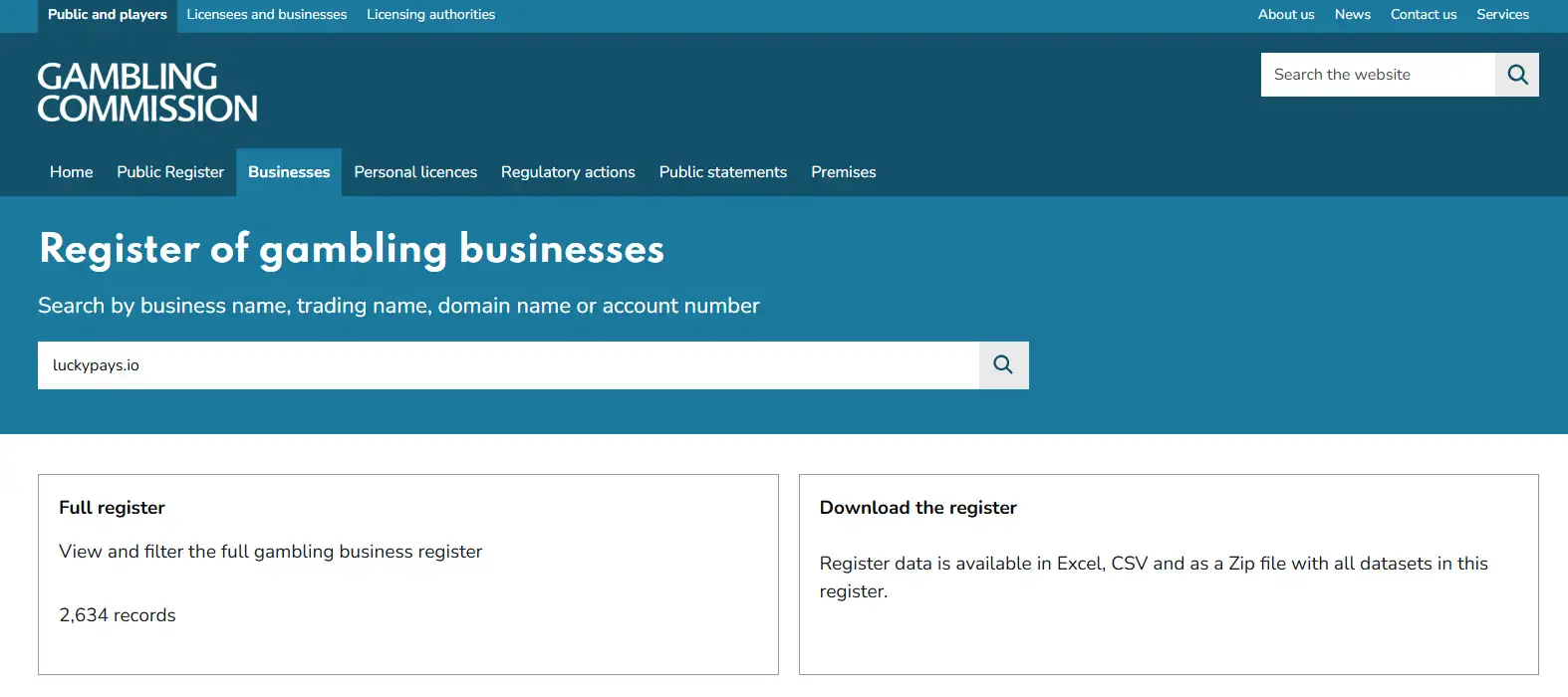
For a UK reader, those are separate checks: the Anjouan record identifies an offshore licensing relationship, while the Gambling Commission register answers the Great Britain licensing question. Neither should be substituted for the other or reduced to a single ‘UK regulated’ label.
Lucky Pays licence details
Lucky Pays is associated with Igloo Ventures SRL and with an Anjouan gambling licence in the Union of Comoros. The licence number associated with Igloo Ventures SRL is ALSI-142311005-FI2. Lucky Pays terms also identify Igloo Ventures SRL in connection with the service, which is why the company name matters when you perform a licence check.
There is an important scope distinction. A company-level Anjouan licence does not automatically establish that every domain used by that company appears on the current licence record. Check the domain list separately before assuming that a particular Lucky Pays URL is covered.
Keep the domain check and the licence check as separate steps. Lucky Pays uses luckypays.io as the primary brand domain, while the licence record is tied to the operator and licence number. If the terms and regulator record show different domain lists, confirm the current domain entry directly while keeping the operator, jurisdiction and licence number as separate pieces of information.
An Anjouan licence is not a UKGC licence and should not be presented as if it grants UKGC dispute handling, UKGC enforcement or Great Britain consumer-protection coverage. Those protections depend on the relevant Great Britain licence status. For a broader evaluation of identity, support and responsible-gambling signals, use the Lucky Pays safety checks page rather than treating one licence label as a complete trust verdict.
Licence details
Lucky Pays is associated with Igloo Ventures SRL. Igloo Ventures SRL is associated with Anjouan licence ALSI-142311005-FI2. The register check did not identify a Great Britain Gambling Commission licence for Lucky Pays. These statements describe different jurisdictions and should not be collapsed into one generic “licensed in the UK” claim.
A useful licence check therefore starts with the legal entity rather than the brand logo alone. Match the operator name shown in the site’s terms with the entity named in the regulator record, then compare the licence number and jurisdiction. After that, check whether the domain you are using appears in the current domain information connected with the record. This sequence helps prevent a genuine company-level licence from being treated as automatic proof that every related or lookalike domain is covered.
What the UKGC register check shows
The Gambling Commission maintains a public register of gambling businesses. Its search supports business names, trading names, domain names and account numbers. The register check did not identify a Great Britain Gambling Commission licence for Lucky Pays or Igloo Ventures SRL.
A register search with no matching licence means a UKGC licence and UKGC-specific consumer protections should not be assumed for Lucky Pays. It does not resolve every legal question or the separate regulatory position in Northern Ireland.
You can repeat the check yourself at the Gambling Commission public register. Search more than one identifier. Start with “Lucky Pays”, then try “Igloo Ventures SRL”, and finally search the domain. A robust check uses the brand, operator and domain because licence records can be organised around a legal entity while consumers know only a trading name.
If a result appears, do not stop at the name. Open the business record and inspect the licence status, trading names, domain names and authorised activities. A similar company name is not enough. The relevant domain or trading relationship must connect the record to the service you are evaluating. The Commission itself notes that domain and trading-name information is supplied by businesses, so the register should be read carefully rather than treated as a one-line badge check.
If no matching record appears, avoid substituting a logo, footer statement or third-party review for the register. Those can be useful leads, but they are not the same thing as a regulator entry. The full review keeps this regulatory distinction separate from product facts such as games, payments and support.
The register is most useful when you search more than one identifier. Try the brand name, the operator name and the domain, then open any plausible result and inspect the licensed business details rather than stopping at a search snippet. A genuine match should let you connect the business, licence activity and relevant web address in a way that is consistent with the site you are using.
If the search produces no matching Lucky Pays record, keep that result separate from the Anjouan licence. An offshore licence can be valid in its own jurisdiction without creating a UKGC licence. For England, Scotland and Wales, the practical point is that UKGC protections and licence conditions should be tied to a verified Gambling Commission record, not inferred from another regulator’s certificate.
Great Britain licensing requirements
Great Britain means England, Scotland and Wales for the regulatory scope discussed here. The Gambling Commission states that most providers of commercial gambling based in Great Britain, or those providing remote gambling to consumers in Britain, require an operating licence. For online casino activity, the relevant framework includes remote casino operating licences.
The main statutory framework is the Gambling Act 2005, amended for remote gambling by the Gambling (Licensing and Advertising) Act 2014. The 2014 changes strengthened the point-of-consumption approach: an operator based outside Great Britain can still require a Gambling Commission licence when it provides remote gambling to consumers in Great Britain. The operator’s offshore location therefore does not by itself remove Great Britain licensing requirements.
This is the key reason the Lucky Pays licence should be described jurisdiction by jurisdiction. The Anjouan licence context answers one question: which non-GB gambling licence is associated with the operator? The UKGC register answers another: is there a Great Britain Gambling Commission licence? The current register check did not identify one for Lucky Pays.
That does not justify a simplistic “legal” or “illegal” label for every UK user. Legal analysis can depend on which nation of the UK is involved, the exact service being supplied, where the operator and player are located, and the regulatory scope at issue. The useful distinction is to describe the licence record and the Great Britain regulatory framework without treating one register result as a universal legal verdict.
For a player, the distinction has practical consequences. UKGC licensees are subject to the Commission’s Licence Conditions and Codes of Practice and remote technical standards. When this site describes UKGC rules below, those rules are being used as a benchmark for the licensed Great Britain market. They are not claims that Lucky Pays has implemented the same controls. The same separation is useful on the games and UK slot context page and the payments and withdrawals guide.
The requirement focuses on the market being served, not simply on where the operator’s company is incorporated. A remote operator that targets or provides gambling to consumers in Great Britain needs the appropriate Gambling Commission permission for that activity. A foreign company registration or offshore gambling licence therefore does not answer the GB licensing question on its own.
For users, the distinction affects which regulatory framework governs the service. UKGC licence conditions, technical standards and consumer-protection rules attach to licensed Great Britain activity. When a brand is not identified on the register, those protections should not be described as though they automatically follow from a different licence jurisdiction.
Why Northern Ireland needs separate wording
Northern Ireland should not be folded into Great Britain for this topic. The Gambling Commission’s Great Britain remit covers England, Scotland and Wales. Northern Ireland has a separate gambling-law framework and should therefore be described on its own terms when a page is written for a UK-wide audience.
The Department for Communities states that gambling in Northern Ireland, apart from the National Lottery, is regulated primarily under the Betting, Gaming, Lotteries and Amusements (Northern Ireland) Order 1985, as amended by the Betting, Gaming, Lotteries and Amusements (Amendment) Act (Northern Ireland) 2022. That framework is not simply the Gambling Act 2005 system transplanted across all four UK nations.
For readers, this means a claim such as “UKGC rules apply throughout the UK” would be inaccurate. The better wording is specific: Gambling Commission remote licensing rules govern the Great Britain market, while Northern Ireland has its own legislative framework. A site can be evaluated against the UKGC register for Great Britain without pretending that the result is a complete description of Northern Ireland law.
The distinction is particularly important because “UK” can blur separate regulatory frameworks. Use “Great Britain” for England, Scotland and Wales when discussing the Gambling Commission market, and treat Northern Ireland separately.
The geographic distinction changes how regulatory statements should be read. England, Scotland and Wales form Great Britain and sit within the Gambling Commission’s remote gambling licensing framework. Northern Ireland is part of the United Kingdom but has a different gambling-law structure, so a statement about what a UKGC remote licence means in Great Britain should not automatically be rewritten as a rule for the whole UK.
For readers, this means checking the jurisdiction behind any legal or licensing statement. If a page says ‘UK rules’ but cites only the Gambling Commission’s Great Britain powers, treat the wording as incomplete. Keep Northern Ireland separate unless the source specifically supports a UK-wide proposition. That approach avoids turning a convenient geographic shorthand into a broader legal claim than the evidence supports.
Current GB rules readers may encounter at licensed casinos
Several current Great Britain rules provide a useful benchmark for what players encounter at UKGC-licensed online gambling businesses. These rules apply to the UKGC-licensed Great Britain market and should not be assumed to apply to Lucky Pays.
| GB rule or standard | Current position | How to use it here |
|---|---|---|
| Online slot stake cap | £5 per game cycle for adults aged 25 or over and £2 for adults aged 18 to 24 | Applies to online slots under remote casino operating licences, not to every casino game and not automatically to Lucky Pays |
| Bonus wagering cap | From 19 January 2026, UKGC licensees cannot apply wagering requirements over 10x bonus funds | A Great Britain promotional benchmark, not evidence of Lucky Pays bonus terms |
| Mixed-product incentives | UKGC licensees cannot combine more than one gambling product within an incentive under the revised rule | Do not assume an offshore promotion follows this structure |
| Gross deposit limits | New terminology and prominence rules take effect on 30 September 2026 | Applies from 30 September 2026; it is a GB rule and not automatically a Lucky Pays rule |
| Financial vulnerability checks | Light-touch checks have been required for remote gambling businesses since August 2024 | This describes the UKGC-licensed remote sector only |
The deposit-limit change takes effect on 30 September 2026. From that date, UKGC rules require gross deposit limits to be offered and given at least equal prominence with other financial limits. Check the current Commission standard when applying the rule.
The slot cap is equally specific. The Gambling Commission says the £5 and £2 maximums apply to online slots and are attached to remote casino operating licences. They do not apply to roulette, blackjack or every other casino product. This is an example of why a regulatory fact should be tied to the exact product and licence scope rather than reduced to a generic statement such as “UK casinos have a £5 limit”.
The promotions rule is another good example. Since 19 January 2026, UKGC licensees are subject to a maximum 10x wagering requirement on bonus funds and a ban on mixing product types within one incentive. The Lucky Pays bonus guide covers the brand’s current offer separately; it does not import the UKGC cap into Lucky Pays terms.
How UK readers can verify the Lucky Pays licence record themselves
Verify Lucky Pays licensing by starting with the exact domain and operator wording shown on the site, then checking the stated Anjouan licence information against the relevant current record.
Run a separate Great Britain Gambling Commission register check instead of assuming that a non-UK licence or site access establishes UKGC authorisation.
Keep the licence jurisdiction, licence number, domain coverage and current operator terms as distinct items, because one verified detail does not automatically prove the others.
Use the registration and KYC for account procedures and repeat the regulatory checks whenever a current licence status materially affects your decision.
Created by the ”Lucky Pays Casino” editorial team.